Reaching Further · 2016-2026
Innovation
In 2023, Yu Yue became President of Harbin Cambridge University, and a student-centered reform took root at this university.

The reform is built on a clear “4-3-2-1” framework: strengthening students’ values at four progressive levels—drive, goodness, discernment, and application; cultivating three literacies—digital, vocational, and humanistic; and implementing two teaching approaches—project-based learning and inquiry-based teaching. The “4-3-2” ultimately converges on the “1”: the institution’s overarching goal—to place student development at the centre and take every student seriously.

This theoretical framework is not just written on paper—it is realized through student activities: orientation galas and sports meets are fully orchestrated by students themselves; it is embedded in the educational environment—the canteen has been transformed into “NEW HOUSE,” a space for dining, socializing, and performance; and it is applied in teaching—teachers no longer lecture unidirectionally, but engage students in authentic projects, where they acquire knowledge and build skills through solving real problems. Only then does the “4-3-2-1” truly take root.

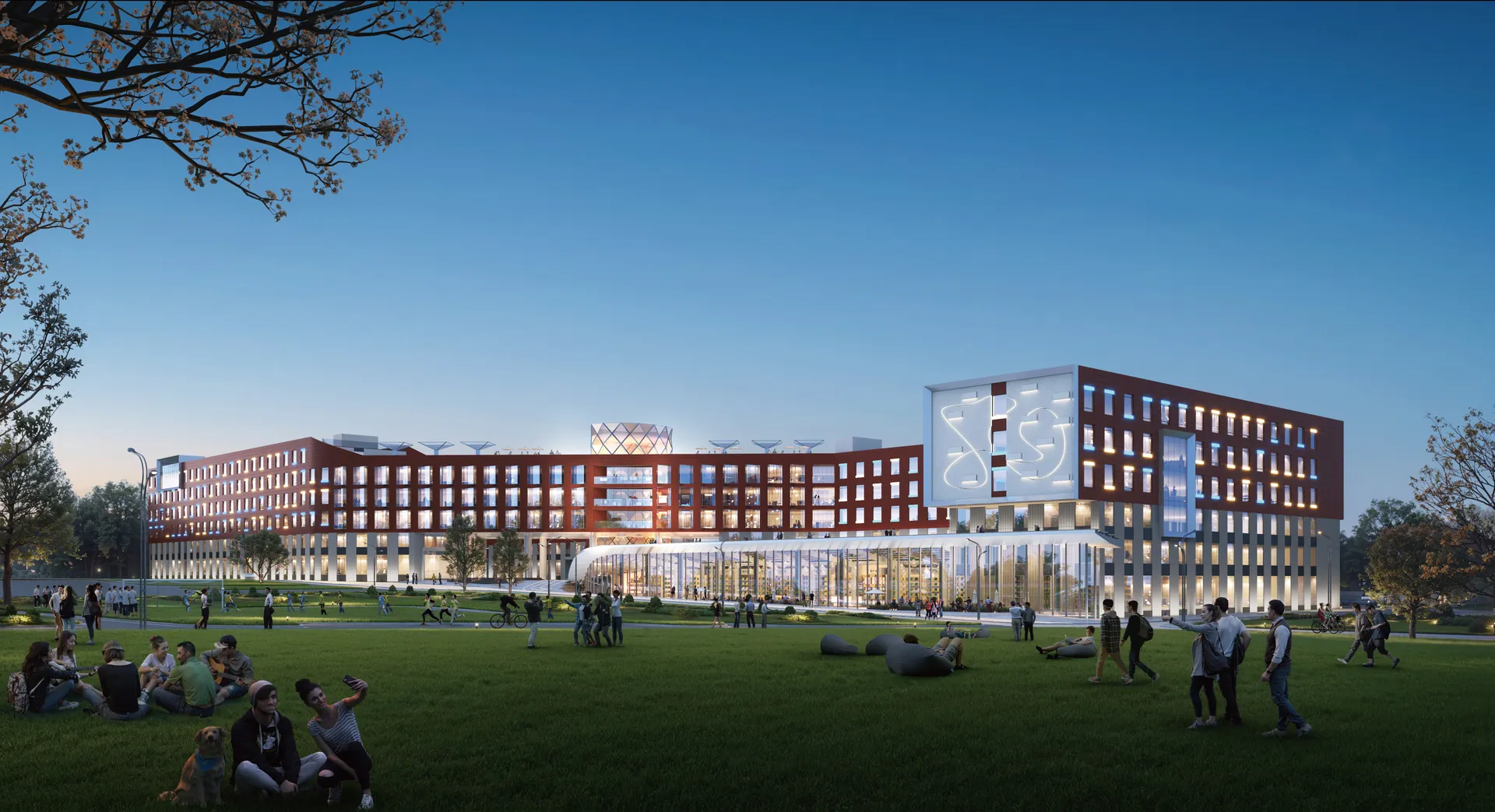
During its development, Yantai City College of Science and Technology has focused on two key domains—“city” and “technology”—while also emphasizing humanistic cultivation. Its campus architecture, as a physical carrier, not only embodies the college’s philosophy but also serves as a space that incubates students’ innovative spirit and practical abilities. The second-phase buildings have become a design benchmark attracting attention from professional media at home and abroad, while the iconic art gallery-equestrian center complex on campus is unique among Chinese universities, offering a space to cultivate students’ aesthetic appreciation and resilience.

Yu Yue firmly believes that a key role of a university is to build platforms for students and provide them with opportunities to broaden their horizons. He has vigorously promoted collaboration between industry-leading enterprises and the group’s higher education institutions, establishing multiple tailored training classes—bringing industry platforms and career development opportunities back to the university—and has repeatedly invited prominent industry figures, renowned entrepreneurs and investors onto campus to share their experiences with students.

As an Honorary Trustee of Peking University, he has brought his alma mater’s finest educational resources and those of other top universities, such as Tsinghua, to OCEG students. Walking with the best and standing alongside the strong is the fastest way to grow. All three group institutions have signed “Applied Talent Training Special Agreements” with PKU’s School of Psychological and Cognitive Sciences.

In 2025, the “Peking University-Longjiang Lecture Series” was officially launched at Harbin Cambridge University, regularly inviting top PKU scholars to conduct high-level academic exchanges in Harbin. The inaugural lecture featured Academician Duan Huiling and Professor Yang Lihua sharing the stage, discussing the humanistic value in the age of AI—bringing the illuminating thoughts of a premier institution to the banks of the Longjiang River.
Photographs


