Gathering Strength · 1996-2005
Crucial Decisions
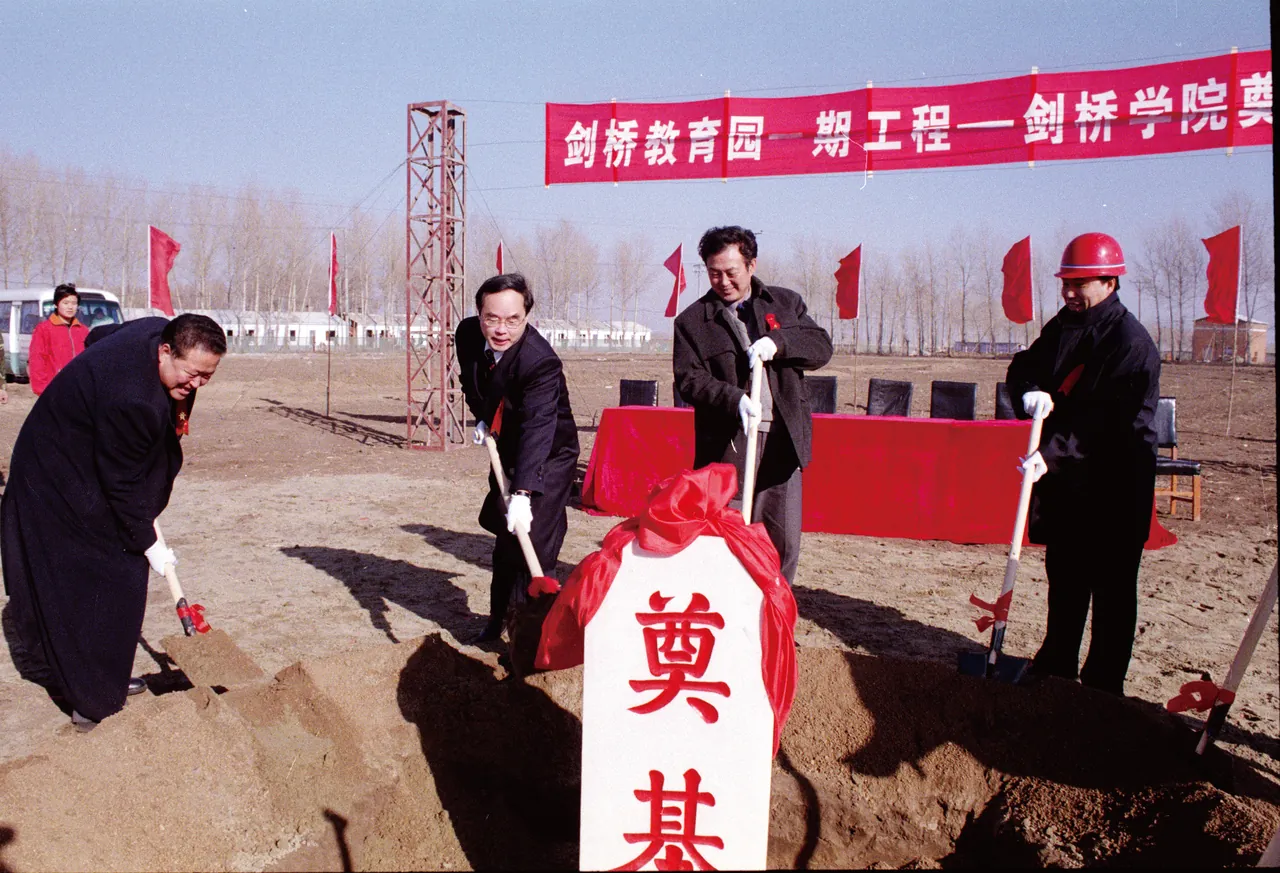
Groundbreaking ceremony for the Harbin Cambridge Education Park
As the new century began, private education enjoyed policy tailwinds.

In 2001, as universities expanded enrollment and the state paid increasing attention to private education, Yu Songling made a decision that many at the time did not understand: he renamed and transferred Beijing Zhongshan College, reallocating the funds and focus to Heilongjiang Cambridge Junior College, with the goal of upgrading it to an undergraduate university within the national enrolment plan. This choice—based on careful consideration of enrolment quotas and construction costs—proved prescient.

Next came a second difficult decision: should they establish a bachelor's-degree or junior-college program? Yu Songling decided that even if a bachelor's program required affiliation with a public university and even meant operating at a loss, they had to insist on offering bachelor's degrees—he firmly believed that the state would eventually allow independent private university operation. To that end, the group built a new campus covering over 178 acres in Harbin. In 2001, Heilongjiang Cambridge Junior College became Harbin University of Science and Technology Cambridge College, entering the state-planned undergraduate enrolment system; in 2003, it entered a joint-program partnership with Heilongjiang University and was renamed Heilongjiang University Cambridge College.

With the higher-education segment steadily advancing, Yu Songling turned his attention to elementary schools and kindergartens. Drawing on years of educational experience and exceptional execution, in 2001, Beijing Zhongshan Experimental School opened; in 2002, Cambridge Elementary School was established in Harbin, and Beijing opened its first bilingual kindergarten—Beijing Zhongshan Experimental Kindergarten. At this point, Yu Songling had truly realized his dream of a seamless education system from kindergarten through university—a rarity in China's private education sector.

In those years, Yu Songling shuttled constantly between Harbin and Beijing. It was grueling, but every task he undertook and every decision he made was driven by his unwavering faith in the power of education. When students faced difficulties, he reached out; when schools were insufficient, he built more; wherever there was need, he went. His original aspiration and goodwill were seen by ever more people—employees and parents willingly offered their family savings when funds ran short, and many strangers lent a hand in times of hardship. Hearts are won one deed at a time: when you walk the right path and do the right work, others will naturally walk with you.
From 1996 to 2005, OCEG completed its second phase of growth: it acquired its own campuses, entered the mainstream of higher education, inscribed its name in the capital, and built a full spectrum of schooling from kindergarten through university. When the faint light first flickered, it lit only a single classroom; when that light gathered into a blaze, it illuminated campuses across multiple cities.