
Gathering Strength · 1996-2005
Putting Down Roots
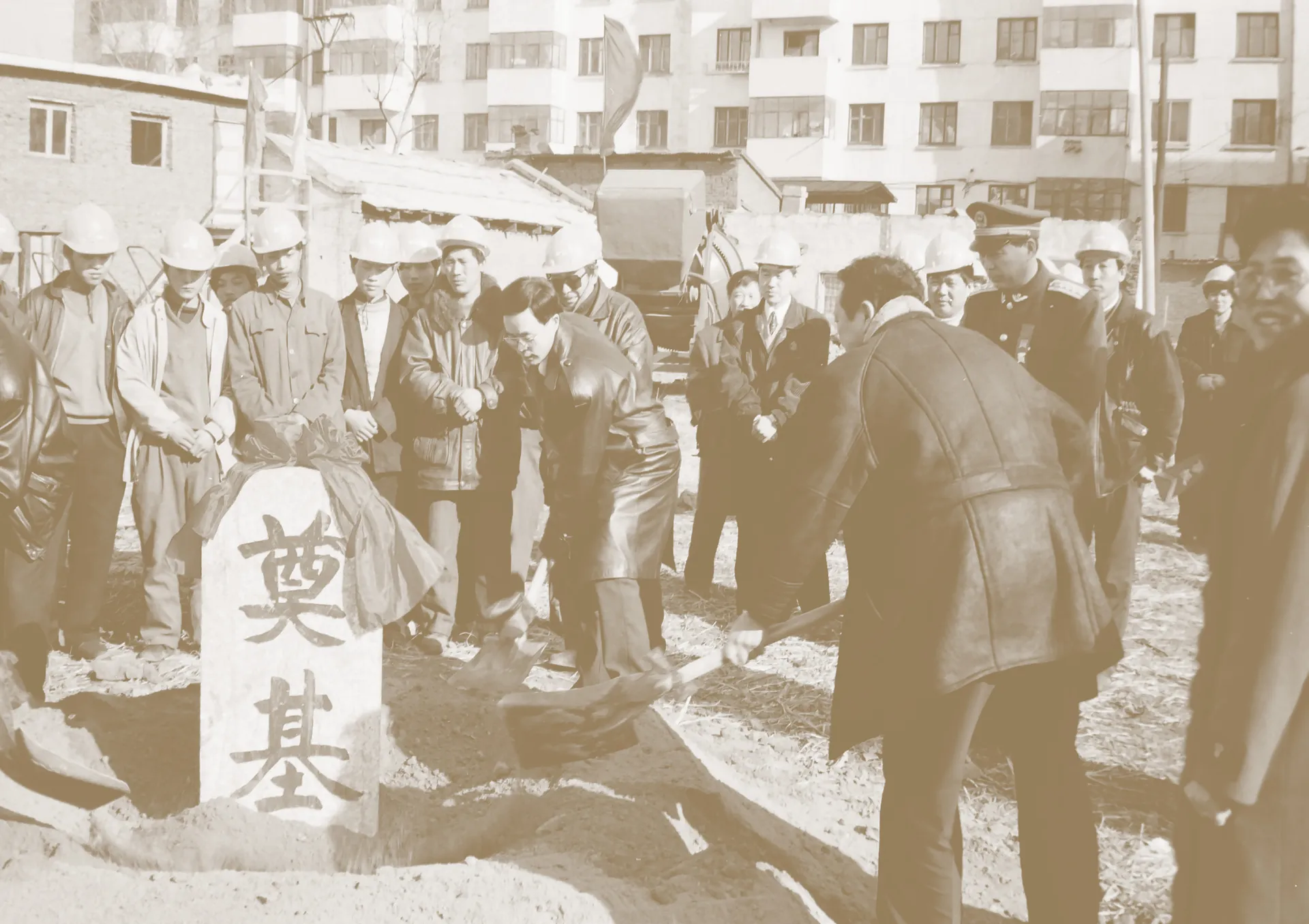
Groundbreaking ceremony of Cambridge No. 1 Middle School, 1997
In the spring of 1997, he spotted a plot of land near Zhongyang Street.

The land cost 4.4 million yuan, and constructing the school building would require another 15 million—an astronomical sum at the time. Where would the money come from? At an executive meeting, some proposed forgoing their salaries and contributing their family savings to the school, and many echoed the idea. A friend delivered 2.6 million yuan in a flour sack. Together with his own savings and a bank loan, within half a month they had gathered the start-up capital.
You're doing the right thing.

Yet entrepreneurship means facing unexpected difficulties at every turn. On April 20, construction came to a halt on its very first day due to a missing “road occupancy permit.” After several days of frantic effort and anxious waiting, the project was finally approved as a “three-at-once” project—construction, permits, and inspection all proceeding simultaneously. Midway through, a funding shortfall nearly stopped work again. Just as Yu Songling, exhausted and ill, was at his wits' end, a student's parent brought 200,000 yuan to ease the crisis. On August 20, the school building was completed. As Yu Songling flipped through the operating permits, he counted 105 official seals stamped on them. The hardships behind those seals were beyond words—but for the students, it was all worth it.
On September 1, Harbin Cambridge No. 1 Middle School opened, with over 500 new students seated in brand-new classrooms. Among the first graduating class, 70% of junior-high students were admitted to key provincial or municipal high schools, and 90% of senior-high students entered universities—including one each to Peking University and Tsinghua University. Ning Yu, who was admitted to Tsinghua, had all tuition and meal fees waived for three years of high school due to family financial difficulties. From then on, offering fee reductions for underprivileged students became institutional policy—for the founders' belief was that education should give more children the chance to study and become people who contribute to their country and society.