The First Light · 1986-1995
A Far Horizon
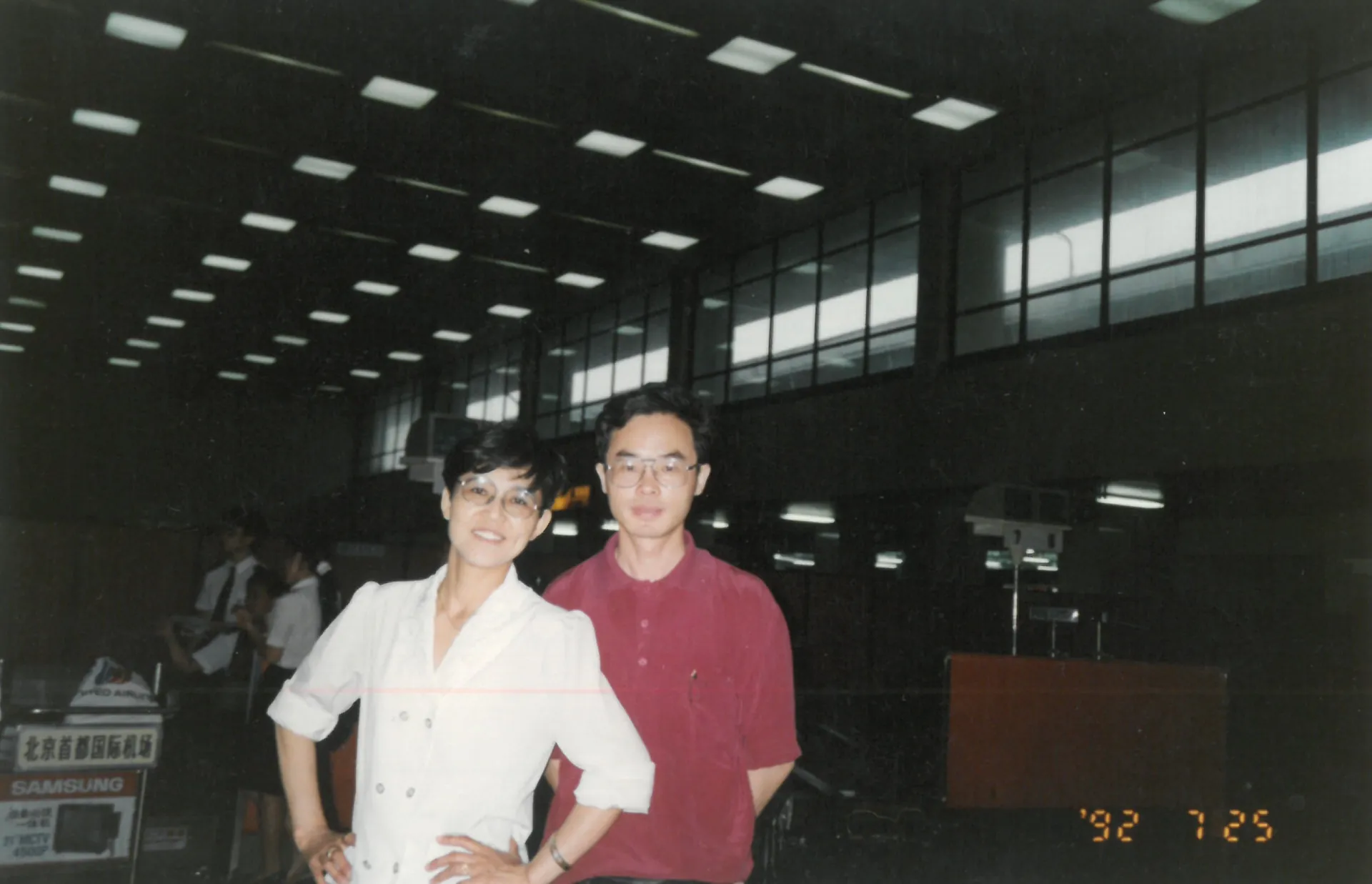
Yu Songling and his wife Wu Huijie at the airport. From starting a business to studying abroad, she supported every choice he made
In the early 1990s, a wave of “study abroad” fever swept across China. Yu Songling took the family’s entire savings—RMB 200,000—and headed to the United States.

He wanted to see for himself what world-class education looked like, and to bring back the best methods for teaching English. He reached out to professors from Harbin Institute of Technology and Heilongjiang University to run a preparatory program for studying abroad, and he sat in on the classes himself, studying alongside the students. He went on to pass the TOEFL and obtain a visa.

Reality, however, gave him a hard lesson. He was working while studying. He slept in a basement and ate one hot meal a day. He refused to move to better accommodation or spend a cent more than necessary—until his employer absconded with his wages, wiping out RMB 200,000 overnight. Standing in a foreign street, he felt not despair but clarity: Oriental Cambridge must control its own classrooms, its own standards, and its own destiny. The group’s later insistence on direct operation over franchising, its solid commitment to quality, and its clear-eyed sense of boundaries—all trace back to those cold, difficult days.

In America, he also encountered a different kind of answer. A classmate’s older sister worked in education in Africa; her younger sister, after earning a medical doctorate, went to teach in India; and the classmate herself planned to teach in rural China after graduation. This family showed him, more vividly than any theory, that education could be a calling—not just a career. In the winter of 1992, he returned to Harbin. He used his duty-free car-purchase quota, granted to returning overseas students, to buy a second-hand minivan and drove it straight back to school. Besides his luggage, he brought back a clearer conviction: his students were in China, and his work was in China.