The First Light · 1986-1995
A New Chapter
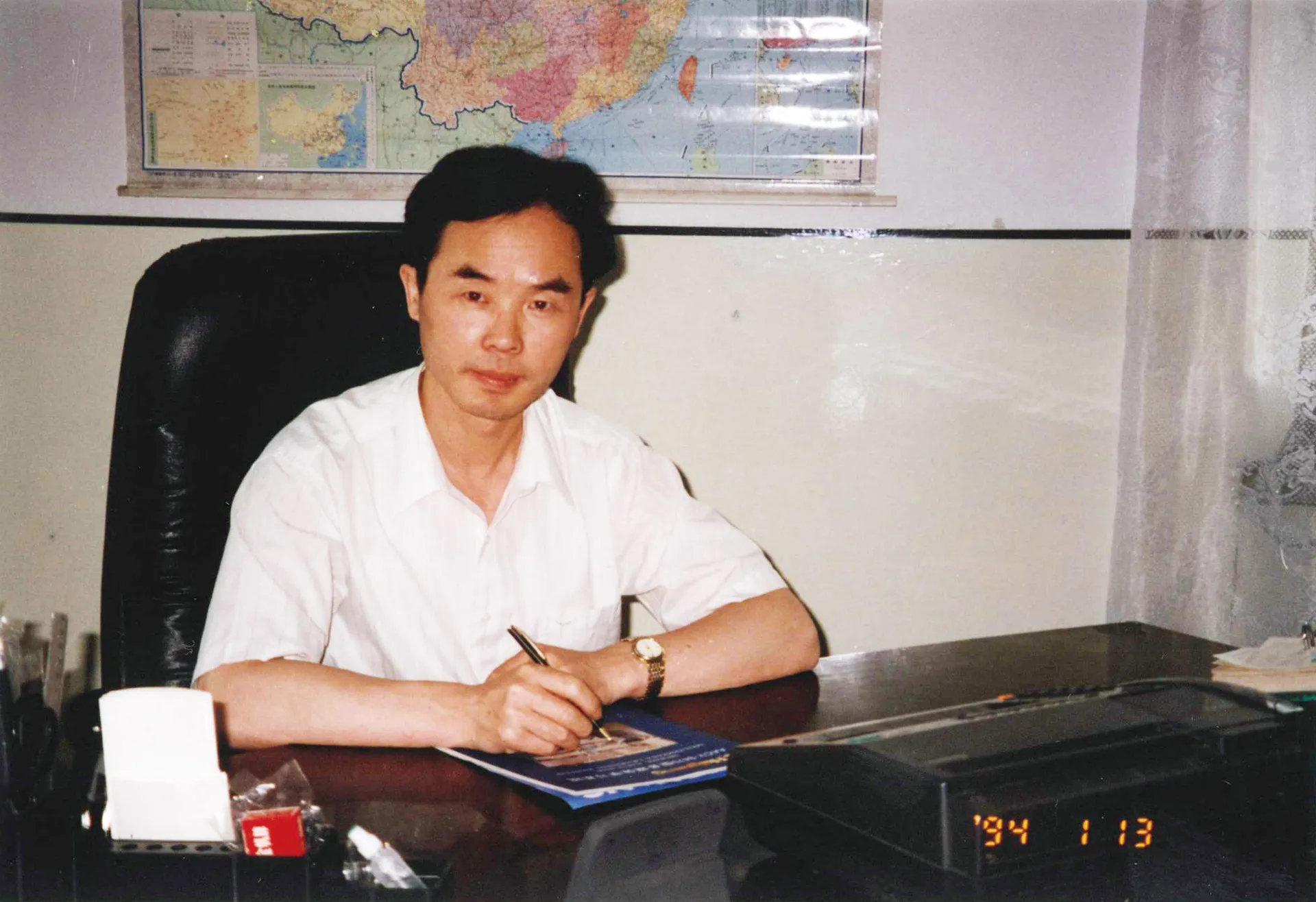
In 1994, Yu Songling finally had the very first office of his own—on the wall, a map of China; in his heart, the map of a future to come
While Yu Songling was in the United States, the Cambridge training school continued to run smoothly under Wu Huijie and her mother. Upon his return, he turned his attention to computers—then just emerging in China but already widespread in America.
In 1993, he travelled alone to Beijing’s Zhongguancun technology hub and brought back ten “286” computers, launching a computer training program. It was an immediate success: applicants queued from the door to the street corner, and students were hired by government agencies, banks, and enterprises even before graduation. The program ran for over a decade, eventually expanding to 300 machines, and laid a solid financial foundation for the school’s growth. For the first time, the founder rented an office and hung a sign on the door: “Principal’s Office.”

By the end of 1994, Yu Songling sat in that office, reflecting on the past nine years. Enrolment had grown from twenty-two to over ten thousand; textbooks and tapes had spread nationwide; Cambridge had built an impressive presence. Yet a quiet voice stirred within him. A parent had once done the math with him: a child’s after-school tuition and fees could easily exceed 10,000 yuan a year—roughly the annual income of an average working-class family. Training, he realized, had its limits. If he wanted stability, scale, and lasting brand value, he would need to move into formal, degree-granting education. And besides—founding a university had been his dream ever since his days teaching at Harbin University of Science and Technology. That winter, as snow fell heavily over Harbin, he sketched out the next decade’s direction on paper: Cambridge would not only offer training—it would also extend to fundamental and advanced education.
In 1995, Yu Songling rented a school building at an annual cost of 400,000 yuan and established Heilongjiang Cambridge Junior College, taking the first step toward higher education. On 1 September that year, the school officially opened—but once again, only about twenty students enrolled. Fate seemed to echo itself deliberately: ten years earlier, a rented classroom and twenty-two children; ten years later, a grander educational dream, still beginning with a handful of young people. Only this time, he was no longer satisfied with teaching just one subject—he wanted to build a pathway for a person’s fuller educational journey.

From 1986 to 1995, OCEG completed its first and most difficult act of self-definition: what is worth doing, how to do it, and who should do it. The answers lay in the eyes of those twenty-two children looking up, in the figure arriving on time through rain-soaked nights, and in the hearts of the twenty-odd young people who set out again in 1995. There was no “group” yet, no complete map—only a classroom, a stack of flashcards, a few boxes of textbooks, and a steadfast refusal to lower standards. A first light had flickered on—not dazzling, but bright enough to illuminate the first stretch of the road ahead.